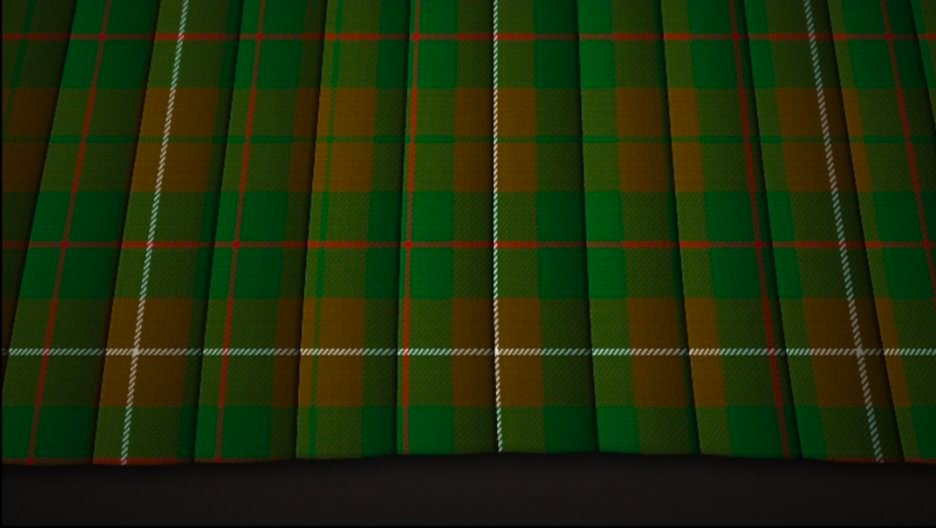
The Prince’s Recipe: The MacKinnons, Drambuie, and a Hunting Tartan in Brown and Green
The story, which the family told for two centuries and printed on the label, goes like this. In the summer of 1746, on the run after Culloden, Prince Charles Edward Stuart was sheltered on Skye by Captain John MacKinnon of Strathaird, who rowed him to the mainland and was imprisoned for it. In gratitude, before they parted, the Prince gave him the one thing he had left to give: the recipe for his own liqueur, a blend of whisky, heather honey, herbs and spices that he had brought with him from France. The MacKinnons kept it in the family and made it in small quantities for their own table for a hundred and fifty years.
None of this can be proved and some of it is almost certainly untrue. A fugitive prince sleeping in caves is not a man with a personal liqueur. But the legend belongs to the MacKinnons, and what they did with it is a matter of record. The family’s hunting cloth, the brown and green MacKinnon Hunting tartan, has a far firmer pedigree than the recipe.
The Broadford Hotel
In the 1870s a MacKinnon family ran the Broadford Hotel on Skye, and they served the drink to guests. One of the guests, in 1873, is supposed to have called it an dram buidheach, the drink that satisfies, and the name stuck as Drambuie. It was registered as a trade mark in 1893 by the hotel’s owner. And in 1909 a Malcolm MacKinnon, who had gone from Skye to Edinburgh to make his way in the wine and spirit trade, began to make it commercially in the city, a dozen cases a year at first, and set up the company that bore his name.
It nearly failed. Then in 1916 the drink was taken into the cellars of the House of Lords, and then it went to the Army, and then to every hotel bar in the Empire, and by the middle of the century Drambuie was the most famous Scottish liqueur in the world, sold in a hundred countries, with the Prince on the label and the MacKinnon family still owning every share. They kept it for a hundred and five years. In 2014 they sold it to another Scottish family firm, and the recipe, the family said, went with it in a sealed envelope, still secret.
It is a remarkable story about a clan: to take a legend, a hotel and a bottle and turn them into a business that outlived every empire the drink was sold in.
Abbots and fugitives
The MacKinnons had been on Skye and on Mull for six hundred years before any of that, and their history has two threads. One is Iona. The MacKinnons were hereditary abbots of the great monastery there for generations, and the last of them, Abbot John MacKinnon, who died about 1500, lies under a carved effigy in the abbey church; the fine cross that stands near it, carved in 1489, is MacKinnon’s Cross. Iona was the MacKinnons’ spiritual home and Skye was their stronghold, and between the two they held Strathaird and Strath on Skye and part of Mull for centuries under the Lords of the Isles and then the MacLeods. The other thread is the Prince. The clan was out in 1745, its chief was imprisoned in the Tower, and the caves and coves of the Strathaird coast where Captain John hid Charles Edward are still pointed out to visitors from the boats.
The clan claims descent from the royal house of Alpin and is counted among the Siol Alpin with the MacGregors and the Grants. Its crest is a boar’s head with a deer’s shank in its mouth. Its motto is Audentes fortuna juvat, fortune favours the bold, which a family that put a fugitive’s recipe on the House of Lords’ wine list has some right to.
Red turned to brown
The MacKinnon clan tartan is a strong red with green and white, in the family of the Prince’s own. The hunting tartan is its quiet relation, and the archives explain exactly how it came to be. The modern hunting MacKinnon, they record, is based on the sett published in the Vestiarium Scoticum of 1842, with one change: the red in that book has been replaced by brown. The result was registered with the Lord Lyon in 1960, when the chief, MacKinnon of MacKinnon, formally recorded both the clan and hunting setts, and the Scottish woollen manufacturers were told by letter which counts were correct.
So the hunting MacKinnon is a green tartan with broad bands of a warm peat brown, a thin red line through the green, and a fine white line at the pivot. It is one of the few hunting setts to use brown as a principal colour rather than blue, and it has a softness, a moorland quality, that suits it to almost anything. It makes particularly good pleated kilts for women, the brown and green opening on every turn.
Retailers offer MacKinnon Hunting tartan alongside the red, in Modern and Ancient colours, made to order as kilts, skirts, sashes, scarves and ties, or by the yard, under the spellings MacKinnon, McKinnon and MacKinnen. It looks, as one might expect, particularly good behind a bar.
Edinburgh, a Friday night in December
Eilidh MacKinnon is twenty-seven and runs the bar at a hotel on the Royal Mile, four floors of stairs, a cellar, and a room full of visitors from every country there is who want to be told what to drink. She is from Broadford. She has grown up with the Prince’s recipe the way other people grow up with a family recipe for shortbread, and she has, behind the bar, the one cocktail she will always recommend, which is the Rusty Nail, whisky and Drambuie over ice, because it is the only cocktail in the world named after a Skye hotel’s hallway, or so she tells the Americans.
She works in a skirt, in the family hunting tartan, and she chose the skirt with the same care she gives a drink. A bar is a job done on the feet, up and down stairs, bending to a low fridge, turning between the till and the shelf a thousand times a night. A tight skirt binds. A full one catches on the bar. What works is knife pleats, stitched flat to the hip, so the skirt is narrow when she stands and opens when she moves and turns, and holds its crease after a night in a hot room and a morning in the wash.
She found it at Scottish Kilt, in the range the outfitters file under pleated kilts for women, and the description was exactly the brief: pleated plaid skirts with sharp knife pleats that hold a permanent crease, in more than five thousand tartans, cut to your own waist and the finished length you send. She sent her waist where the skirt would sit and the length to just above the knee, standing in her work shoes, and it came in three weeks in the brown and green with the red and white lines, in a washable worsted that has now been through the machine forty times and has not lost a pleat. She has two of them now, one on and one drying, which is the only sensible arrangement for a garment worn five nights a week.
She wears it with a white shirt, a black waistcoat, black tights and flat black shoes, and a bar apron over it for the messy jobs, and on a Friday in December a man from Ohio, who has ordered the Rusty Nail and is pleased with it, asks about the tartan.
“MacKinnon. Hunting. It’s my name.”
“Like the Drambuie people?”
“Same clan. Different bank balance.” She sets down the glass. “The Prince gave a MacKinnon the recipe in 1746, so the label says. My gran says the Prince didn’t have a recipe. He had a boat and a lot of trouble.”
“So it’s not true?”
“It’s a legend. It sold a lot of bottles.” She turns to the till, and the pleats open and close. “This is true, though. Registered with the Lord Lyon in 1960. Brown where the book had red. You can check.”
Fortune favours the bold
The MacKinnons were abbots of Iona, hid a prince in a cave, and turned a story they could not prove into a bottle in every bar on earth, and kept it for a hundred years. Whether or not Charles Edward ever owned a liqueur, the family’s nerve was real, and so was the business.
Their hunting tartan is brown and green with a thread of red, made from a book by changing one colour, and registered with the heralds by a chief who wanted it right. In knife pleats behind a bar on the Royal Mile, on a woman from Broadford pouring the drink the family made famous, it is exactly where it belongs.